AI chatbots can handle enquiries, quotes, reminders, and after-hours support for travel agencies, but some jobs still need a human. Here is what to automate and what to keep.
Quick answer: A travel agency can automate most repetitive customer conversations with an AI chatbot: answering common questions, capturing and qualifying leads, drafting itinerary ideas, sending quotes and booking updates, and handling after-hours enquiries in several languages. Jobs that involve complex trips, payments, disruptions, and sensitive judgment calls should stay with a human, or at least need human approval. The agencies that get the best results connect the chatbot to their real data, make it answer from approved sources, and make handing over to a person easy.
Travelers are already comfortable asking AI for help. In the Allianz Partners Global Travel Confidence Index (polling by Ipsos, fieldwork in March and April 2026), about 37% of Americans planning summer travel said they use AI to help plan their trips. They use it for recommendations, itineraries, budgets, and research.
For a travel agency, that raises a practical question: which parts of the job can a chatbot take over, and which parts are better left to your people?
What Is an AI Chatbot for a Travel Agency?
Older chatbots followed fixed scripts and broke as soon as a customer asked something unexpected. Modern AI chatbots understand free-form questions and reply in natural language, in the customer's own words and often in their own language.
For travel agencies, the useful ones are usually built in one of two ways:
Customer-facing chatbots answer enquiries on your website, WhatsApp, or social channels, and collect details from potential customers.
Agent assistants work behind the scenes. They help your consultants find information, draft itineraries, and write replies faster.
Both work best when they use Retrieval-Augmented Generation (RAG). With RAG, the chatbot first searches your own approved material, such as packages, policies, supplier notes, and FAQs, and then writes its answer from what it found. That keeps answers tied to your real offers instead of whatever a general model might guess. Our RAG chatbot cost guide explains how this works in more detail.
What Can a Travel Agency Automate With an AI Chatbot?
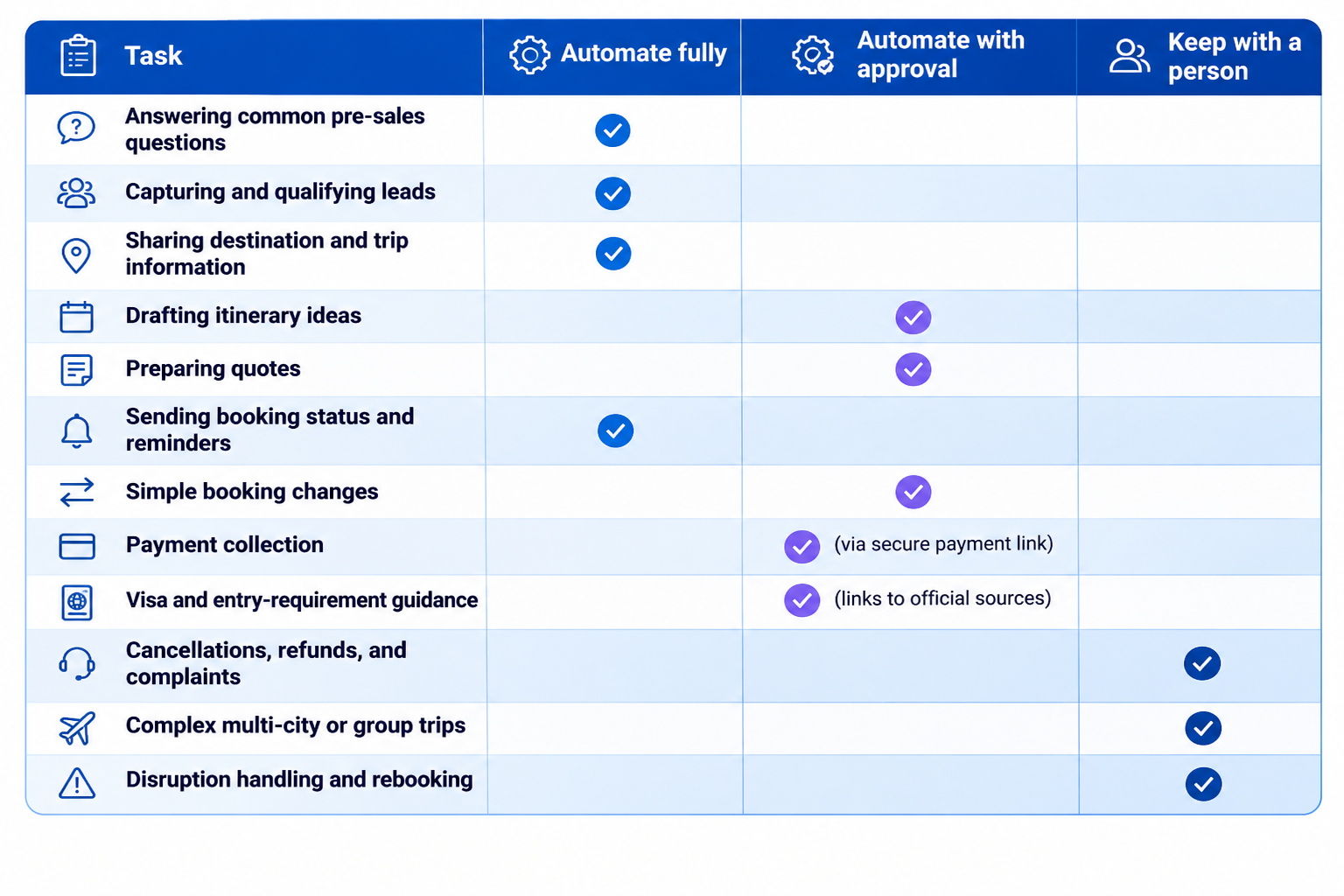
The table below sorts common tasks into three levels: safe to automate, automate with a human approving, and keep with a person.
1. Answering common questions, around the clock
Customers often ask the same things: what is included in a package, what the cancellation terms are, when final payment is due, what the weather is like. A chatbot can answer these instantly, at any hour, and in several languages. That matters if you serve travelers across time zones, since many enquiries arrive when your office is closed.
2. Capturing and qualifying leads
A chatbot can ask the questions a consultant would ask first: where and when, how many travelers, what budget, what style of trip. It can then pass a complete, organized enquiry to the right person. This saves your team from chasing missing details, and it means a visitor who messages at midnight gets a reply instead of a silence.
3. Drafting itinerary ideas
AI is good at producing a first draft of an itinerary from a customer's preferences. The key word is draft. Opening times, travel times between stops, and availability still need checking, and a consultant should review the plan before it goes to a customer.
4. Quotes, booking updates, and reminders
Once a booking exists, a lot of messages are routine: confirmation, payment reminders, document checklists, pre-trip information, and post-trip feedback requests. These are good candidates for automation, especially when the chatbot is connected to your booking records so the details are always current.
5. Simple booking changes
Small requests, such as updating a traveler's name spelling or adding a transfer, can be handled by a chatbot that creates a request for your team to approve. This keeps a human in control of anything that changes a reservation.
6. Multilingual support
If your customers speak different languages, a chatbot can reply in each one. Have a speaker of each language review sample conversations before launch, since travel terms and tone vary between languages.
7. Helping your own consultants
Some of the best returns come from tools your team uses internally. A RAG assistant can search supplier contracts, destination notes, and past itineraries so a consultant gets an answer in seconds instead of hunting through folders and emails. It can also draft replies for the consultant to edit and send.
What Should You Keep Human?
Some parts of travel are about judgment, trust, and reassurance. A chatbot is a poor fit when:
The trip is complex. Multi-destination, multi-supplier, or group trips need an experienced planner.
Something goes wrong. A cancelled flight or a medical issue needs a person who can make decisions and calm a worried traveler.
Money is disputed. Refunds, compensation, and complaints should reach a human quickly.
The customer asks for a person. Always make this easy. Few things frustrate a customer more than a chatbot that will not let go.
The topic is high stakes. Visa rules, health requirements, and safety advice change often, and a mistake can strand a traveler.
A useful principle: let the chatbot handle the routine and the repeatable, and use the time it saves for the work that builds relationships and earns repeat bookings.
What Are the Risks of Using AI Chatbots in Travel?
1. Wrong answers can become your problem
In Moffatt v. Air Canada (British Columbia Civil Resolution Tribunal, February 2024), an airline's chatbot told a grieving customer he could claim a bereavement fare discount after travel, which was wrong. The airline argued that the correct policy was elsewhere on its website and that the chatbot was responsible for its own statements. The tribunal rejected both arguments and held the airline liable for negligent misrepresentation. The amount was small (about C$650 plus interest and fees), but the principle was not: a company is responsible for what its chatbot says.
For a travel agency, that means a chatbot should not invent prices, policies, or visa rules. It should answer from approved sources, show where an answer came from, and say "I'm not sure, let me connect you with a consultant" when it lacks evidence.
2. Payment card data
If customers type card numbers into a chat, those numbers can end up in chat logs, transcripts, and analytics tools, which can bring those systems into scope for payment card security rules (PCI DSS). A common safer design is to keep card numbers away from the chatbot entirely. The chatbot sends the customer to a secure, hosted payment page or payment link, and your payment provider handles the card data. Tell your payment provider how you plan to take payments in chat before you build.
3. Sensitive personal data
Travel bookings involve passport numbers, dates of birth, family details, and travel dates that reveal when a home is empty. Collect only what is needed, store it securely, restrict who can see it, and define how long you keep it. Make sure your privacy notice covers chatbot conversations, and check the data-protection laws that apply to your customers, such as GDPR for travelers in Europe. Our guide to AI chatbots for law firms covers data-safety principles, such as vendor checks and access controls, that apply here as well.
4. Telling people they are talking to AI
Some regions require this. Under the EU AI Act, the main chatbot transparency duty (Article 50) applies from 2 August 2026, meaning systems designed to interact with people must make clear that the user is dealing with an AI, unless that is already obvious. Even where no law requires it, saying so builds trust. Check the rules in your markets with a legal adviser.
5. Out-of-date prices and availability
Travel information changes constantly. A chatbot reading from a fixed list of documents can quote a price or an offer that expired last week. For anything that changes, such as prices, availability, or promotions, the chatbot should read from live data in your booking system or send people to the live page, rather than rely on stored text.
6. Over-automating the relationship
Travelers are often making one of the biggest purchases of their year. A chatbot that feels like a wall between them and a real adviser can cost you the booking. Make handover to a person simple, fast, and visible.
How Do You Build a Travel Chatbot That Actually Works?
The agencies that benefit most tend to follow the same principles:
Answer from approved sources. Load your packages, policies, terms, and FAQs, and have the chatbot answer from them with links back to the source.
Connect to live systems. Link the chatbot to your booking system, CRM, and supplier data, so quotes, availability, and booking status are current. How easy this is depends on your systems, so list them early.
Go where customers already are. For many agencies this means WhatsApp, the website, and social messaging, with the same conversation history shared across them.
Use secure payment links. Keep card details out of the chat.
Build in a clear escape hatch. Hand over to a consultant with the whole conversation attached, so the customer never has to repeat themselves.
Add guardrails. Define what the chatbot must not do, such as quoting prices it cannot verify, giving visa advice without pointing to official sources, or promising refunds.
Test with real questions. Gather real customer questions, check the answers against your policies, and test the awkward cases: unusual requests, angry customers, and questions the chatbot should not answer.
Monitor and improve. Review conversations regularly, fix gaps, and re-test when your offers or policies change.
How Should a Travel Agency Roll Out an AI Chatbot?
Choose one or two high-volume tasks. FAQs and lead capture are good starting points because they are repetitive and lower-risk.
Gather and clean your content. Remove outdated packages and conflicting policies. Poor source material produces poor answers.
Pilot with a small group. Start with one channel or one product line and have consultants review conversations.
Measure the results. Track first-response time, how many enquiries become bookings, how often the chatbot hands over to a person, answer accuracy, and customer satisfaction.
Expand step by step. Add quotes, booking updates, and reminders once the basics work, and move into booking changes with approval flows only after that.
Keep a person accountable. Assign someone to own the chatbot's accuracy, review conversations, and update its content.
How Can Vyntics Help?
Every travel business has different products, systems, and customers. Vyntics builds custom RAG systems and AI assistants, including document processing, search, source citations, evaluation, integrations, and deployment, designed around how your agency actually works.
As an example of this approach, Vyntics built an AI-powered compliance research assistant for a higher-education client that answers from an approved set of documents, links every answer to its sources, and says so when it lacks enough evidence. The field is different, but the same principles apply to a travel chatbot. You can read more in the Vyntics Compliance RAG Chatbot case study.
Explore our RAG & Knowledge Assistants and AI Agents services, or our Data Pipelines & Integration service if you need to connect your booking and CRM systems.
Thinking about a chatbot for your travel agency? Book a strategy call with Vyntics. We will talk through your customers, your systems, and the tasks worth automating before any development begins.
Frequently Asked Questions
What can a travel agency automate with an AI chatbot?
Common questions, lead capture and qualification, destination information, booking reminders, post-trip feedback requests, and after-hours support. With human approval, it can also help draft itineraries and quotes and handle simple booking changes.
Can an AI chatbot book trips for customers?
Technically, yes, if it is connected to your booking systems. Many agencies prefer a safer approach in which the chatbot prepares the booking request and a consultant approves it, with payment taken through a secure payment link.
Will an AI chatbot replace travel agents?
For routine enquiries, it can take on a lot of work. It is much less suited to complex trips, disruptions, complaints, and relationship-building. Most agencies get the best results by using AI to free their consultants for the work that needs a person.
Can a chatbot work on WhatsApp?
Yes. Many travel agencies use WhatsApp as a main customer channel, and chatbots can be connected to it. You will need access to WhatsApp's business tools, and the chatbot should hand over to a person smoothly when needed.
Is it safe to take payments through a chatbot?
Only with the right design. Avoid letting card numbers enter the chat. Send customers to a hosted payment page or secure payment link, so your payment provider handles card data. Check the setup with your provider.
What happens if the chatbot gives wrong information?
Your agency can be held responsible for it. In Moffatt v. Air Canada, a tribunal held an airline liable for wrong information from its chatbot. Reduce the risk by having the chatbot answer from approved sources, show citations, decline when unsure, and hand over to a person.
Does a travel chatbot need to tell people it is an AI?
In some places, yes. The EU AI Act's chatbot transparency duty applies from 2 August 2026. Even where it is not required, disclosure builds trust. Check the rules in your markets.
Can a chatbot give visa advice?
It can share general information and point to official government sources, but visa and entry rules change often and mistakes have serious consequences. Have the chatbot link to official sources and add a note that the traveler should confirm requirements, with a consultant available for questions.
What systems does a travel chatbot need to connect to?
Typically your website, a messaging channel such as WhatsApp, your CRM, and your booking or reservation system. Supplier and inventory data may also be needed for live availability and prices. The effort depends on how open your systems are.
How do I know if a travel chatbot is working?
Track first-response time, the share of enquiries that become bookings, the rate of handover to a human, answer accuracy against your policies, and customer satisfaction. Review real conversations regularly, not only the numbers.
Sources and Further Reading
Allianz Partners Global Travel Confidence Index, as reported by Hotel Dive
American Bar Association: BC tribunal confirms companies remain liable for information provided by an AI chatbot (Moffatt v. Air Canada)
PCI Proxy: The PCI problem with AI travel agents and conversational booking
McCann FitzGerald: EU AI Act transparency compliance
The PCI Proxy article is published by a payment-security vendor. This article is general information, not legal advice. Check the rules that apply in your markets.
The best travel chatbots do not try to replace the people who make a trip special. They take over the repetitive work so those people have time for the conversations that win loyal customers.