For many business RAG chatbots, PostgreSQL with pgvector is the simpler and cheaper choice. Here is when it wins, and when Pinecone is the better fit.
Quick answer: For most business RAG chatbots, PostgreSQL with the pgvector extension is often the simpler, cheaper, and easier-to-secure choice, especially if your data already lives in Postgres and you are working with up to a few million (and sometimes tens of millions of) vectors. Pinecone is the stronger choice at very large scale, for unpredictable traffic, or when you want no database work at all. This guide explains why, and how to decide.
Every RAG chatbot needs a place to store and search the "meaning" of your documents. The two options people compare most often are PostgreSQL with pgvector and Pinecone.
PostgreSQL is one of the most widely used open-source databases. pgvector is an open-source extension that lets it store embeddings and run similarity search.
Pinecone is a fully managed database built only for vector search.
Embeddings are lists of numbers that represent the meaning of a piece of text. A RAG chatbot compares your question's embedding with your documents' embeddings to find relevant passages.
If you are new to the topic, our guide to RAG chatbot costs explains how RAG works and what it costs to run.
⚠️ Please note: This is a general comparison, not a recommendation for your specific project. Benchmarks cited here were run by vendors, and both products change often. Always test with your own data.
Why Is PostgreSQL Often the Better Choice for RAG?
1. Everything lives in one database
A RAG chatbot rarely needs vectors alone. It also needs document details, user accounts, permissions, chat history, and audit logs.
With PostgreSQL, all of this sits in one place. You can search vectors and filter by date, department, or document owner in a single SQL query, with transactions that keep everything consistent. With Pinecone, vectors live in a separate service, so you have to keep two systems in sync every time a document is added, changed, or deleted.
2. Security and permissions are easier to manage
Businesses usually need to make sure people only see documents they are allowed to access. PostgreSQL has long-standing tools for this, including role-based access and row-level security, so the same rules that protect your other data can protect your chatbot's search results.
It also means one fewer external service holding a copy of your content, which can simplify security reviews.
3. Costs are often lower and easier to predict
Pinecone's paid plans start with a monthly minimum ($50 on Standard and $500 on Enterprise, as listed on Pinecone's pricing page in November 2026) and then charge for storage, reads, and writes. That model works well for light or unpredictable usage. At steady, higher usage, the read and write charges add up.
With PostgreSQL, you pay for the database compute and storage you choose, and your vector search can share a server you may already be paying for. Two vendor-run benchmarks point in the same direction:
Supabase (2023): On a dataset of 1 million embeddings, pgvector on an instance costing about $410 a month handled several times more queries per second than Pinecone setups costing about $480 a month, at similar accuracy.
Tiger Data (2024): On 50 million embeddings, PostgreSQL with the pgvectorscale extension reported much lower latency and higher throughput than Pinecone's storage-optimized index, at a self-hosting cost of about $835 a month against $3,241 for Pinecone.
These are vendor tests, and they are a few years old. The self-hosted figure also leaves out the time your team spends running the database. Treat them as a sign of what is possible, not a guarantee.
4. Filtering and hybrid search fit naturally into SQL
Real questions are rarely "find similar text" and nothing else. They are closer to "find similar text from the HR handbook, published this year, that this user can access."
In PostgreSQL, those conditions are ordinary SQL. You can also combine vector search with built-in full-text search so that exact terms, such as a policy number, are matched alongside meaning-based results. pgvector 0.8.0 (released in late 2024) added iterative index scans, which help when a strict filter would otherwise leave too few results.
5. A mature, proven ecosystem
PostgreSQL has decades of tooling behind it: backups, point-in-time recovery, replication, monitoring, and support for nearly every programming language and framework. Your team may already know how to run it. Even Pinecone's own comparison page acknowledges that Postgres is ahead on recovery and tooling.
6. Less lock-in
pgvector is open source, and it runs on many managed Postgres services. If you outgrow one host or want to switch providers, your data and queries move with you. A proprietary service has its own API and pricing, which makes switching more work.
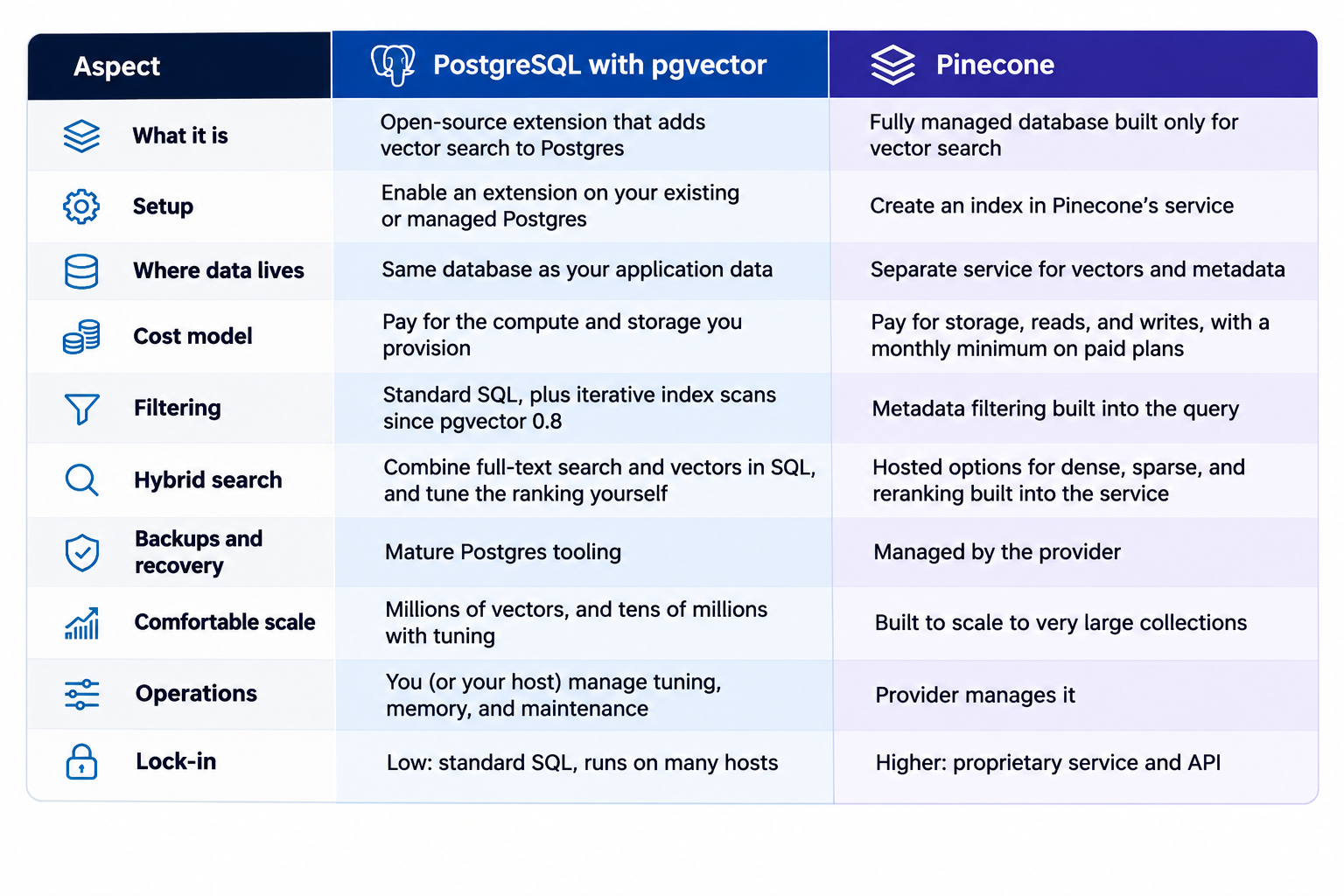
How Do PostgreSQL (pgvector) and Pinecone Compare?
When Is Pinecone the Better Choice?
Pinecone is a strong product, and there are clear cases where it wins:
Very large collections. Hundreds of millions or billions of vectors are hard to run in a single Postgres server. One vendor's rule of thumb is that a pure Postgres setup stops being the simplest option somewhere around a billion vectors, and needs real tuning from about 10 million.
No database team. If nobody on your side wants to manage indexes, memory, and tuning, a managed service removes that work.
Spiky or unpredictable traffic. Pinecone's serverless model scales up and down without you resizing a database.
Built-in search extras. Pinecone offers hosted hybrid search, reranking, and embedding models in the same service, so there is less to assemble.
Very high-dimensional embeddings. pgvector can index up to 2,000 dimensions on its standard type and up to 4,000 with half-precision vectors. Pinecone says it supports far more.
Many separate tenants. Pinecone's namespaces make it easy to separate data for large numbers of customers.
Pinecone's own comparison page also argues that once a Postgres index no longer fits in memory, performance drops sharply. That is a fair point, and it is the main reason to plan capacity early.
What Should You Watch Out for With pgvector?
PostgreSQL is not free of trade-offs. Plan for these from the start:
Memory. The fastest index type (HNSW) works best when the index fits in memory. One estimate is roughly 20 to 25 GB of memory per million 1,536-dimension vectors once index overhead is included, so size your server accordingly.
Filtering with approximate search. Strict filters can return fewer results than you asked for. Turn on iterative scans (available since pgvector 0.8) and test your most selective filters.
Dimension limits. Embeddings with more than 2,000 dimensions need half-precision storage or dimension reduction before they can be indexed.
Index maintenance. Frequent updates and deletes need regular vacuuming, or search quality can slip.
Tuning. Index settings, memory, and query settings all affect speed and accuracy. This is where an experienced team earns its keep.
Common fixes include half-precision vectors to cut storage, partitioning data by tenant or department, and quantization for very large collections.
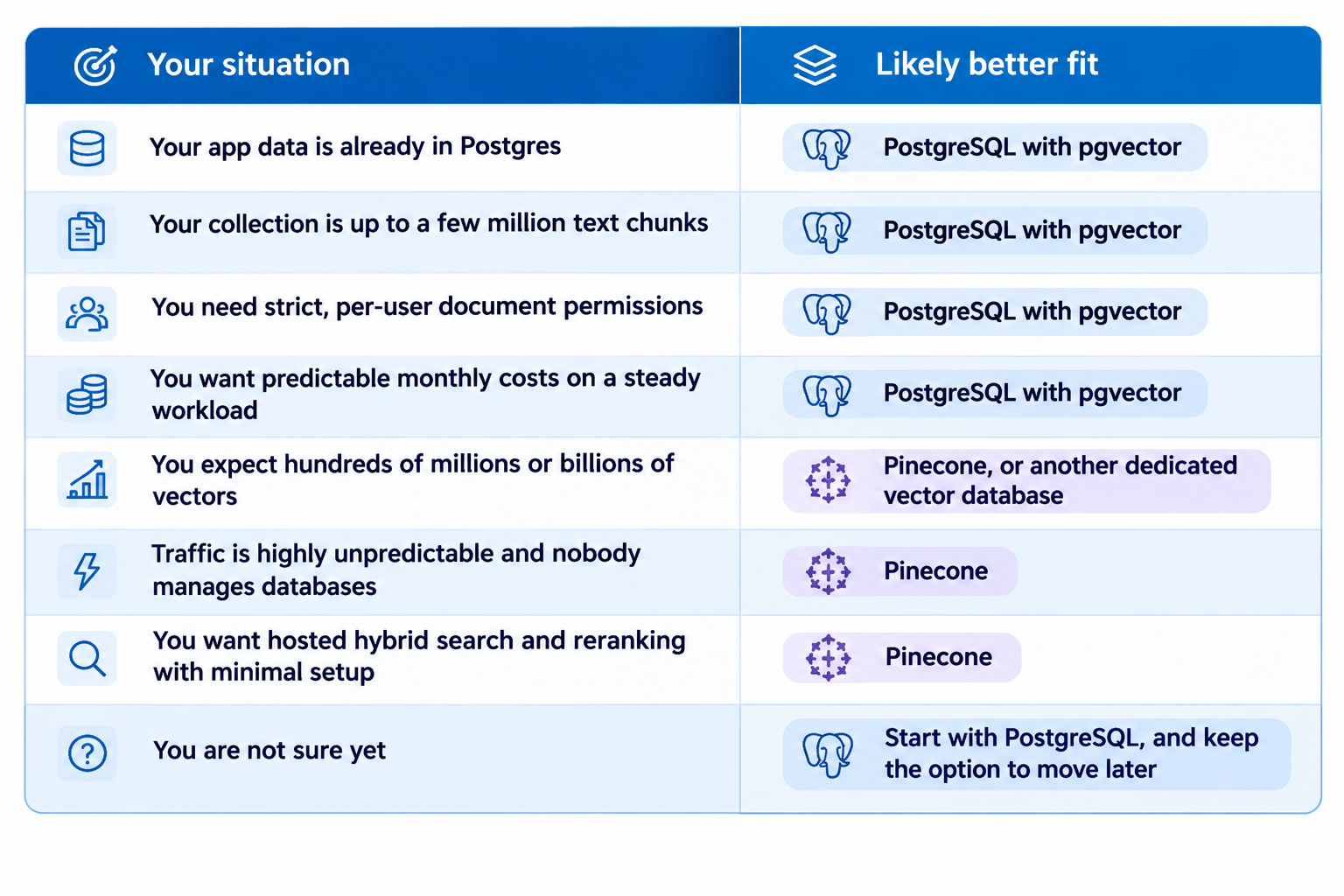
Which Should You Choose? A Simple Decision Guide
How Can You Test Both Options With Your Own Data?
Published benchmarks rarely match your workload. A short test with your own documents is more reliable:
Pick a representative sample of your documents, ideally 5 to 10 percent of the full collection.
Write 50 to 100 real questions, with the documents that should answer them.
Load the same data into both systems, using the same embedding model.
Measure how often each returns the right passages, along with response time under realistic load.
Test your strictest filters and permission rules, since this is where differences show up.
Estimate the monthly cost at your expected volume, including the time your team spends on upkeep.
The accuracy section of our RAG chatbot cost guide covers metrics such as context precision and faithfulness that you can use in step 4.
What Is a Hybrid Approach?
You do not have to choose only one. Some teams keep PostgreSQL as the system of record for documents, users, and permissions, and add a dedicated vector database later only for the largest or fastest workloads. That keeps your core data simple while leaving room to grow.
How Does Vyntics Approach This Choice?
Vyntics has built RAG systems using both Pinecone and Supabase/PostgreSQL, so we do not treat either as the answer for every project. The right choice depends on your data volume, security rules, traffic patterns, and how much database work your team wants to take on.
You can see an example of one of our RAG builds in the Vyntics Compliance RAG Chatbot case study.
If you are deciding where to store the data behind a RAG chatbot, explore our RAG & Knowledge Assistants service. You may also find our Data Pipelines & Integration service useful for preparing and syncing your documents.
Choosing a vector database for your chatbot? Book a strategy call with Vyntics. We will review your data, security requirements, and expected usage before recommending an approach.
Frequently Asked Questions
Is PostgreSQL better than Pinecone?
It depends on your project. For many business RAG chatbots with up to a few million vectors, PostgreSQL with pgvector is simpler, cheaper, and easier to secure. Pinecone is often the better fit at very large scale or when you want a fully managed service with no database work.
Can PostgreSQL replace a vector database?
For many use cases, yes. With the pgvector extension, PostgreSQL can store embeddings and run fast similarity search. A dedicated vector database becomes more attractive at very large scale or for demanding latency needs.
How many vectors can pgvector handle?
It depends on your server, embedding size, and index settings. Millions of vectors are comfortable on a well-sized instance, and tens of millions are possible with tuning. Beyond that, plan carefully or consider a dedicated vector database.
Is Pinecone cheaper than PostgreSQL?
Not always. Pinecone's free Starter plan and usage-based pricing can be cheaper for small or occasional workloads. At steady, higher usage, a Postgres server you already run is often cheaper. Compare both using your expected number of queries and documents.
Does pgvector support hybrid search?
Yes, though you build it yourself. PostgreSQL has built-in full-text search, and you can combine its results with vector similarity in SQL. Pinecone offers hosted hybrid options that need less assembly.
Can I start with PostgreSQL and move to Pinecone later?
Usually yes. Your source documents stay the same, and embeddings can be re-indexed in another system. Plan for the re-indexing time and keep the same embedding model so results stay consistent.
Which is better for a small business chatbot?
For most small business chatbots, PostgreSQL with pgvector is a practical starting point. It keeps everything in one place, and a small collection of documents fits comfortably in a modest database.
Does Pinecone have a free plan?
Yes. Pinecone's Starter plan is free, with limits on storage, reads, and writes. Paid plans start with a monthly minimum. Check Pinecone's pricing page for current limits.
Sources and Further Reading
Pinecone pricing
Pinecone: Pinecone vs pgvector
Supabase: pgvector vs Pinecone, cost and performance
Tiger Data: pgvector is now as fast as Pinecone at 75% less cost
PostgreSQL News: pgvector 0.8.0 released
ClickHouse: How to scale vector search in Postgres
Several of these sources are published by vendors that sell their own products, so their benchmarks should be read with that in mind.
The best vector database is the one that fits your data, your team, and your budget. For many companies, that starts with the PostgreSQL they already run, and it can grow into something more specialized only if the workload demands it.